Wild Fields
The steppe is bigger than you, and in the end it wins.
You are a 17th-century Cossack out of the Wild Fields. You lead your party across a world map of Europe, fight, trade and survive from spring to winter, while the game counts how many years you lasted before the road took you.
Not "a hero saves the world". You play not to win, but so that your life weighed something: how many years you stood, whom you saved, what fame you left behind.
All of Europe on one sheet
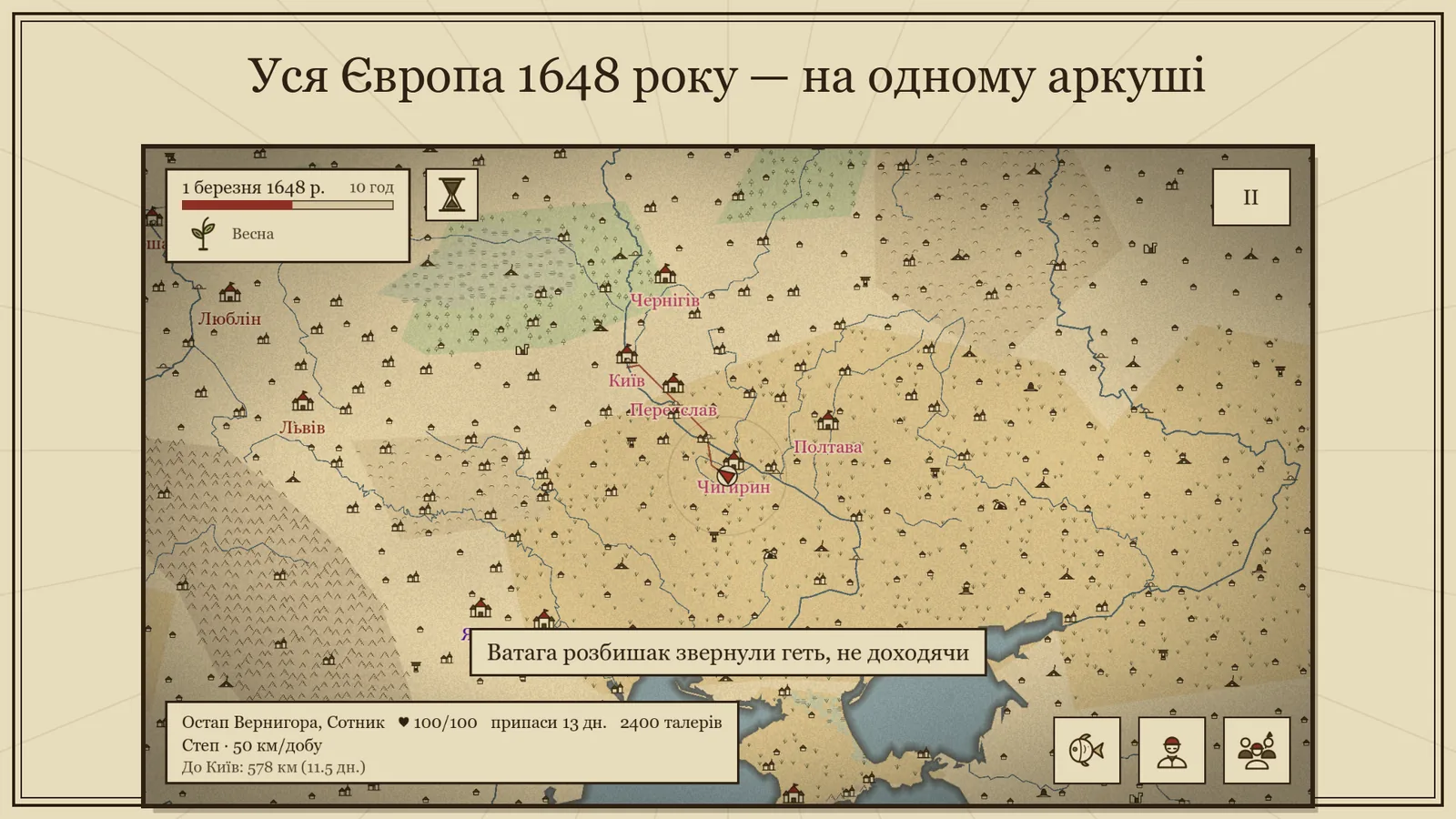
The map is the real geography of 1648 in true latitude and longitude, drawn like an engraved 17th-century chart: parchment, ink, symbols instead of colour blocks. Movement works like Mount & Blade — tap anywhere and the party walks there overland, rounding mountains and forests.
Large rivers can only be crossed at fords — there are thirty-eight of them, each with a name. When the land runs out, the party boards a ship on its own, though the sea is twice as slow. Between two points here, the line is not always straight.
Time moves only while the party is busy: on the road, at a trade, or at a camp you hold yourself. You can think about the route for as long as you like — nobody charges you supplies for it.
Eight trades, eight different games
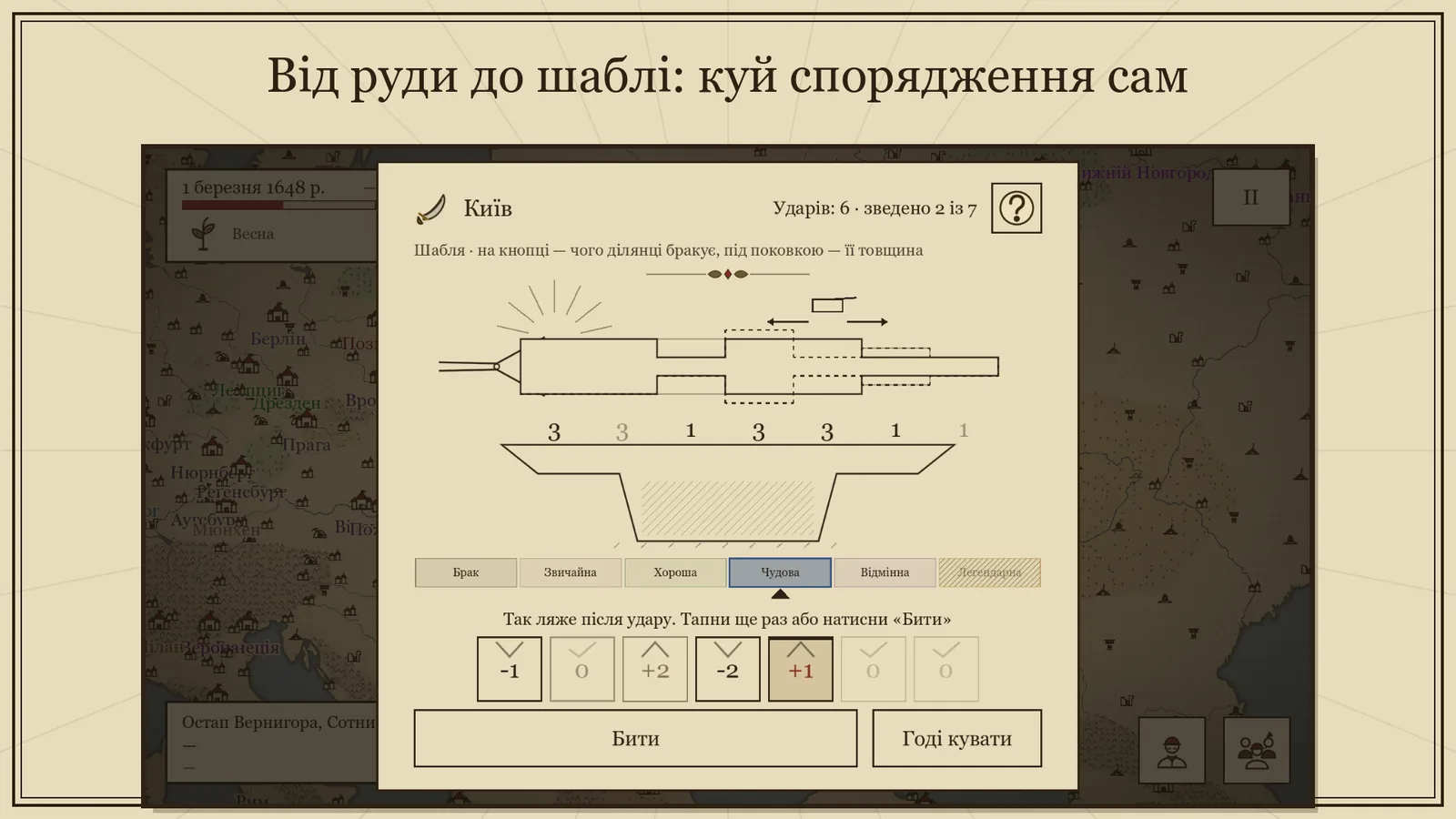
By a river or the sea you can cast a line; in a forest, a marsh or the mountains you can stalk an animal; at a mine you can descend into the face; in a village you can hire on for a day in the fields. In a town you can stand at the furnace and smelt ore into metal, or sit at the loom and weave cotton into cloth. In a large city, metal and cloth become a thing: a smith forges weapons and armour, a tailor sews clothes.
Every trade has its own minigame, its own skill and its own spoils — not the same screen with a different icon. The mower counts his way back, because what he cuts becomes impassable swath and his load grows heavier with every step. The weaver sees the pattern for one pass before it is taken away. At the furnace the heat must be held, not hit — and ore can come out as nothing but slag.
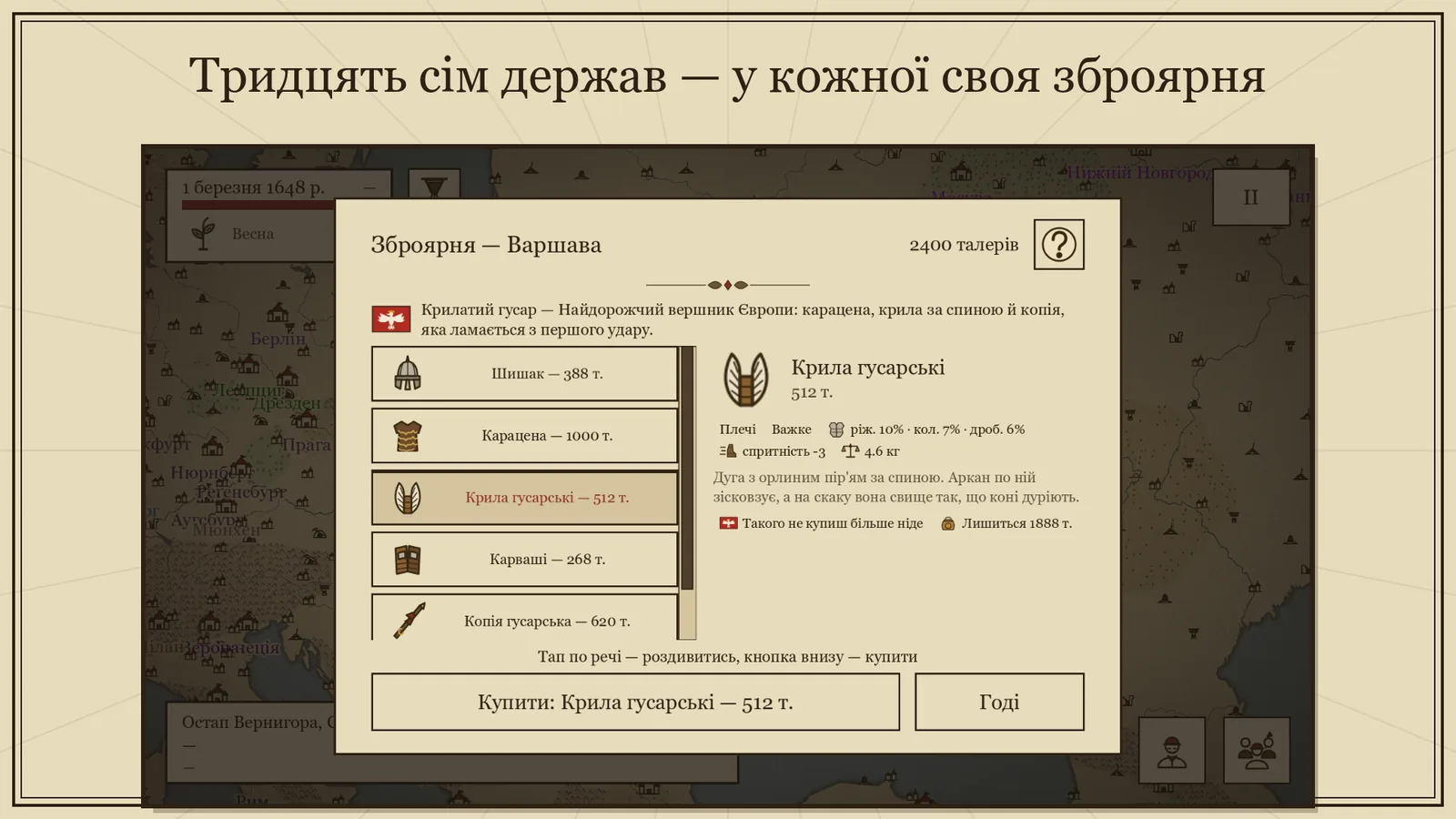
Crafting produces quality: the tier is decided by how you play, and the ceiling on that tier by your skill. There are a hundred and forty-five blueprints, and nearly all of them are sold only by the academy of a large city.
The party
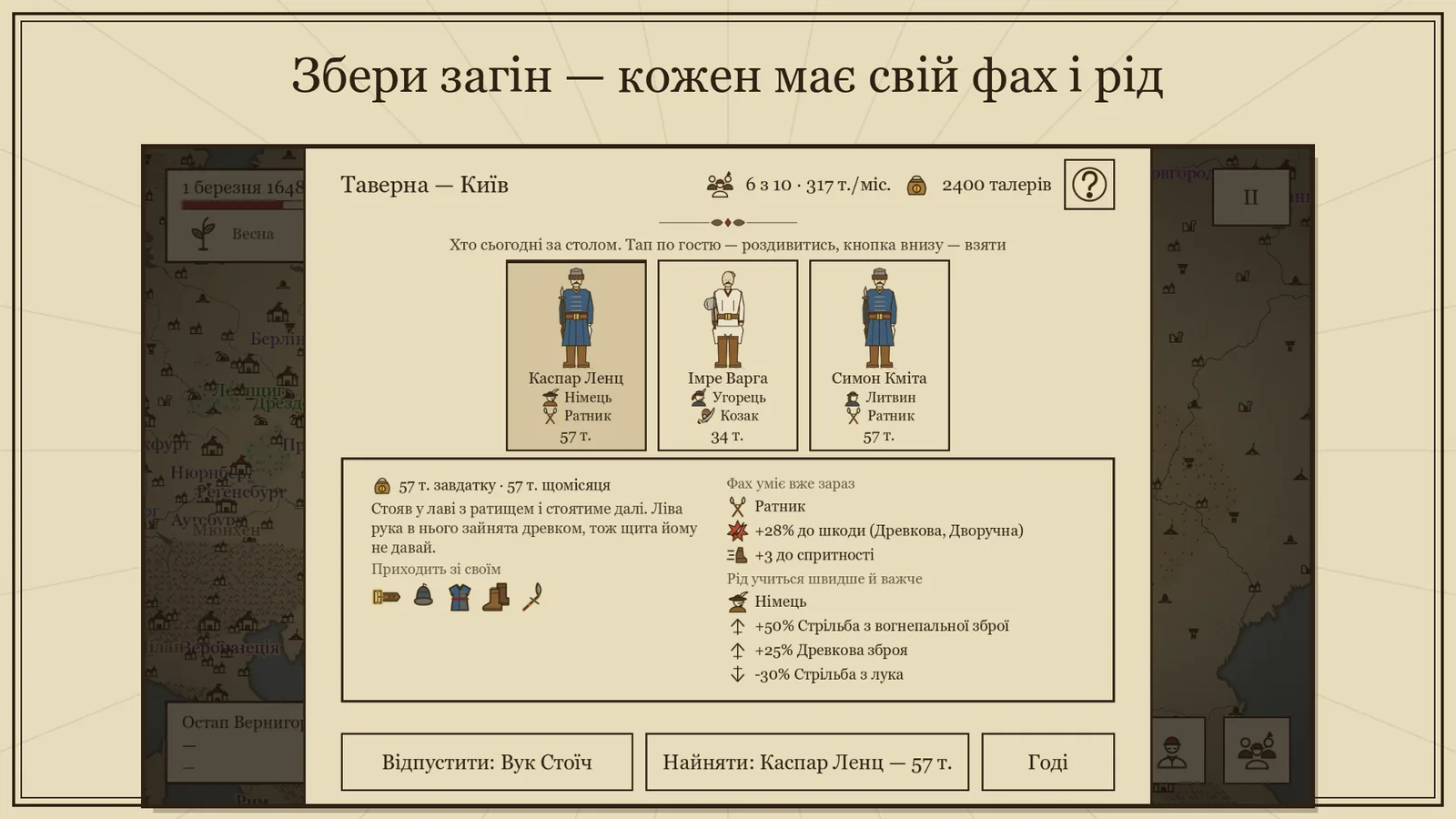
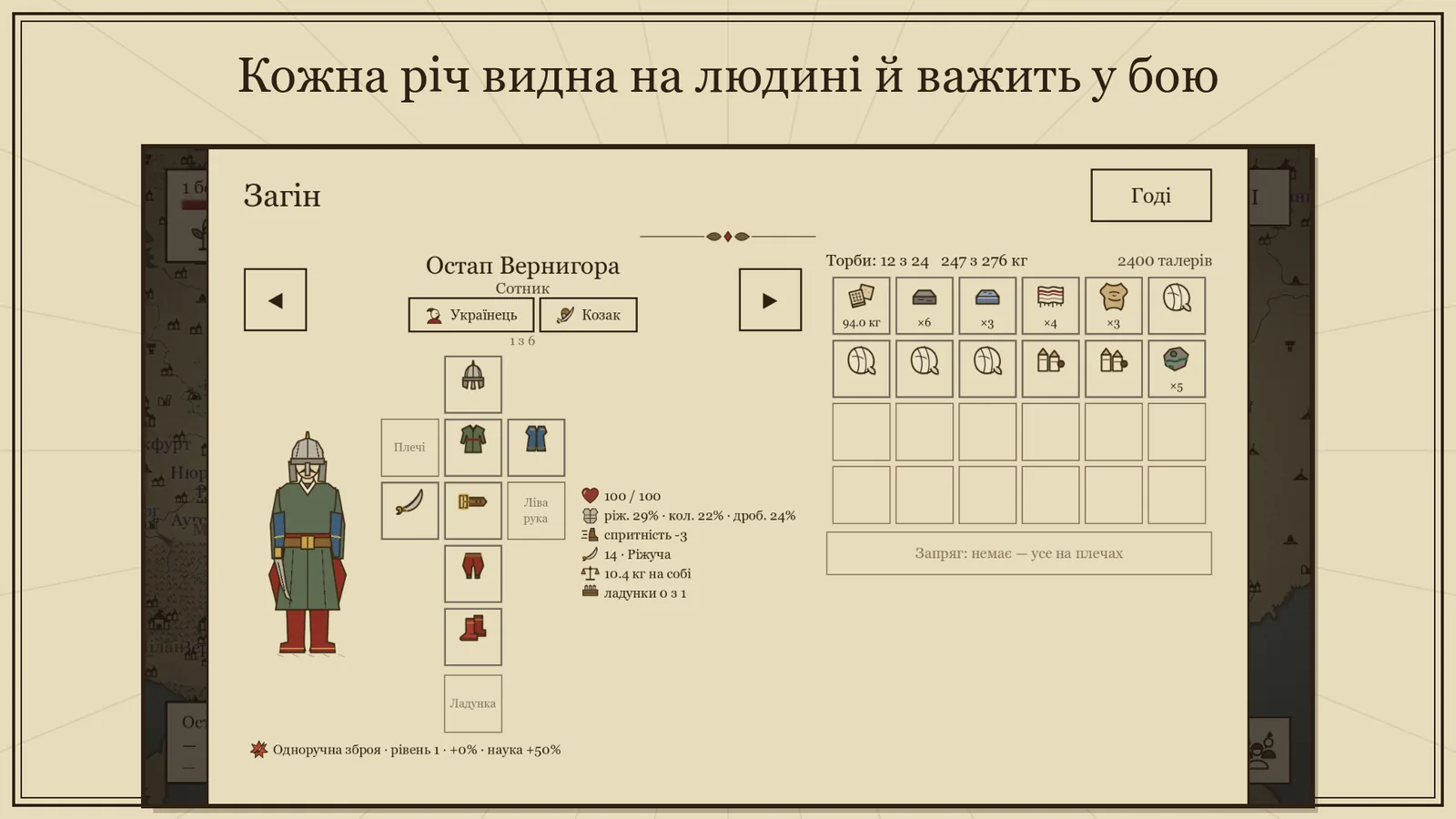
It starts with one person: a zhupan, boots, the tools of a trade and rusks in the bags. Alone you will win no fight at all, so the first days are a journey towards people. Companions are hired in a city tavern for a deposit and wages on the first of each month; with the leader there can be up to ten of you.
Two separate things describe each of them. A trade — six of them, from Cossack to knight — gives a bonus to exactly the equipment the person was trained for. A people — six nations — says which combat skill they learn faster than others and which never comes to them. The two roll independently, so hiring is one decision rather than two.
Supplies are not a separate number: everything the party eats sits as stacks in the bags, and bags have a weight limit you pay for in speed. Hunger takes health and stops wounds from closing.
A road where you are met
Other bands move across the map on their own — whether you are watching them or not, and even while the game is closed: each one's position goes into the save. A party and a band measure each other by a single strength; one that is no more than a level below you moves to cut you off, at the point on the road you have yet to reach. A weaker one scatters, and then it is you who decides whether to chase.
Not everyone on the road is a brigand. Polish traders haul carts from town to town, Muscovite peasants carry their goods to market, Swedish patrols circle their own cities. Attacking someone's people sours things with their country, and at a hundred points of offence a state declares a hunt for you.
Every encounter has three exits: fight, pay off, or run.
Combat on hexes
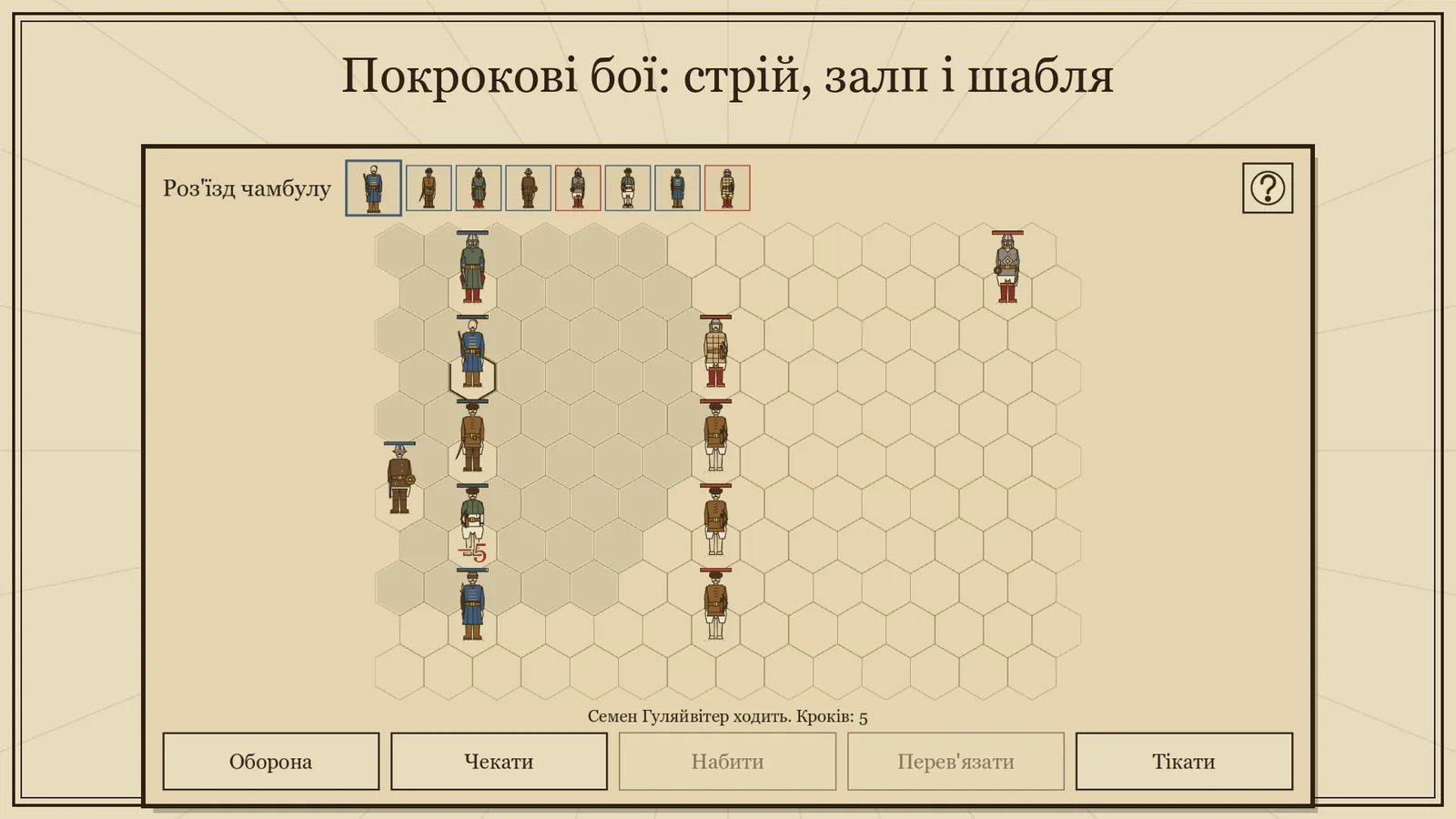
Turn-based, on a 14×11 field, up to ten per side. The turn order builds from initiative accumulated out of agility. Terrain gives obstacles and cover from gunfire, scars remain as the price of victory, and captivity ends in a ransom.
A world that lives without you
Thirty-seven states with banners and diplomacy, eighty-five regular armies with real commanders, treasuries fed by settlements, and town prosperity from one to a thousand — which war ruins and peace rebuilds. States fight each other, besiege cities and pass them from hand to hand.
Capitals have the ruler's chambers: with a centurion's fame and a party of four you are taken into service — and other people's wars become yours. The court hands out commissions paid from its own treasury.
The road grows worse with every year you live. Party progression lives inside a run and burns away on death — you live a new life each time, built from familiar bricks.
Screenshots
Parchment and ink
The style is taken from engraved 17th-century maps. Tap a screenshot to enlarge it.
Questions
Straight answers
Is Wild Fields like Mount & Blade?
The world map works the same way — you tap a point and your party walks there overland. Everything else differs: combat is turn-based on hexes rather than real-time, progression burns away when you die, and eight trades each have their own minigame.
Is the map of Europe historically accurate?
The coastline, rivers, mountains and towns use real latitude and longitude for 1648, and mines sit in genuine ore districts. It is an artistic interpretation of historical geography, not an academic source.
Does progress carry over between runs?
No, and that is deliberate. Party progression lives inside a single run and burns away on death. What the game keeps is the count of how many years you lasted.
Does Wild Fields have ads or purchases?
Neither. The game requests no permissions at all — not even internet access — so it cannot show ads or send analytics even in principle.
How many people can a party hold?
Up to ten including the leader. Companions are hired in a large city tavern for a deposit and wages on the first of each month, and your rank limits how large the party may grow.
Fair rules
- No ads, no purchases. Thalers are earned by the road, by trade and by craft.
- No network. The game never goes online and collects no analytics.
- Your progress is yours. The save sits on the device and goes nowhere.
- Time moves only while you play. No timer will wake you.
Details are in the privacy policy and the terms of use.