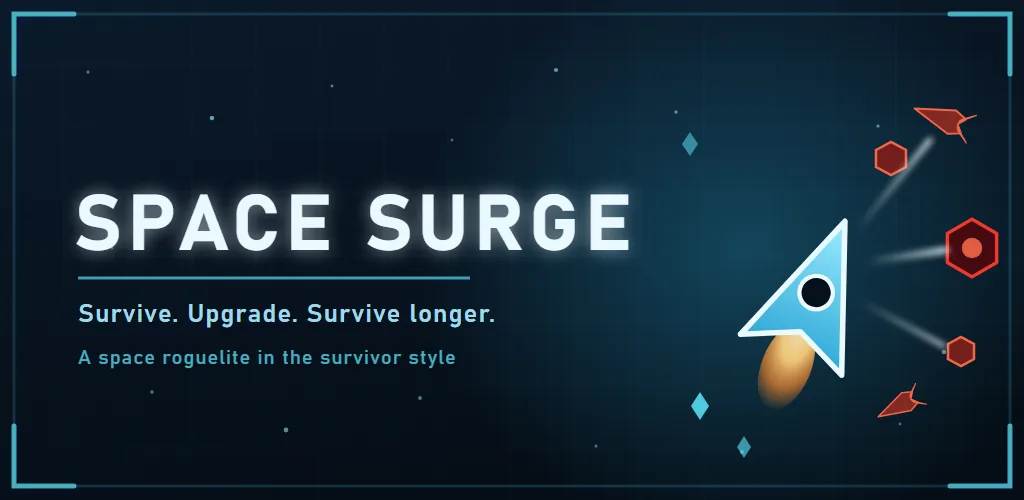
Your ship fires by itself. Every second there are more enemies. The only thing you do with your thumb is decide where to be, once the screen no longer has room for the things killing you.
Space Surge is a bullet heaven — the same family as Vampire Survivors, but set in space and carrying a meta layer that genre usually lacks. A run lasts up to fifteen minutes and can end in three different ways, only one of which is a victory.
The run
You pick a planet and a difficulty, and from there everything is a question of density. Weapons fire automatically by their own rules; your job is to read the field and collect experience. Every level gives you a choice of cards: a new weapon, an upgrade to one you carry, or a passive.
There are fifteen kinds of passive — health, speed, armour, pickup radius, experience multiplier, regeneration, damage, fire rate, crit, pierce, ricochet, multishot, lifesteal, detonation and an orbital shield. You can hold seven of them in a single run, each up to level five, which means a build is always a refusal of something else.
The game deliberately never offers a card that would do nothing for you: Pierce will not appear if none of your guns reads it.
Weapons that outgrow themselves
Six families — machine gun, Tesla coil, railgun, rocket launcher, laser and grenade launcher — in three sizes each. Eighteen modules in total, and every family reads modifiers its own way: pierce means "one more enemy straight through" for the machine gun, more targets per beam for the laser, a wider blast for the rocket, and a shallower chain falloff for the Tesla.
Take a weapon to its maximum level, raise the matching passive, and an evolution card appears. The machine gun becomes a shotgun, the Tesla becomes a Storm that hits everything around it with no falloff, the laser becomes a piercing beam with no target limit, and the grenade launcher starts leaving a minefield behind.
An evolution is a price, not a gift: the passive that unlocked it will never be offered again for the rest of the run.
The hangar between runs
The ship is not a picture but an assembly: bridge, hull, engine, guns, control modules and service modules. The hull sets your health and which slots exist at all. Reactors produce energy, and if consumption ever exceeds generation the run simply will not start — something has to go.
Ship speed is written on no stat line: it is computed from engine power divided by the total weight of everything you hung on it. A stronger gun is a heavier gun. A full cargo hold of minerals is weight too.
Parts are crafted from minerals mined on the planets, upgraded with credits up to +50, and raised through five quality tiers from green to gold.
Where to fly
Eight planets, from the quiet Terra to Erebus, where enemies are three and a half times tougher. All of them are open from the start; what unlocks is not the planet but the difficulty on it, and separately for each. Every planet has its own mineral, its own price per unit, its own weight in the hold and its own boss with a distinct skill set and three phases.
Plus a daily challenge, identical for everyone and determined by the date: planet, difficulty, a modifier (fragile enemies, double swarm, ranged only, frenzied pace), a goal and a reward. A streak adds up to ten per cent per day.
Inside
Systems
Each of them exists so that a run is never the same run twice.
Ship assembly
Six part categories, slots in three sizes, and an energy balance that will not let you launch with more than the reactor carries.
Six evolutions
Maximum weapon level plus the required passive, and the module changes its mechanic rather than its numbers.
Three-phase bosses
One per planet: ring volleys, spirals, charges, summoned minions and blinks. Below a third of its health a boss also speeds up.
Captains
Mini-bosses between waves — a third of a boss's health, one or two skills, their own compact HUD bar, and never next to the boss itself.
Star gates
You can leave a planet early: the haul is banked, but it does not count as a victory and unlocks no difficulty.
Daily challenge
One for everyone, fixed by the date: planet, difficulty, modifier and goal. A streak raises the reward up to double.
Questions
Straight answers
Is Space Surge free?
Yes. Space Surge is free on Google Play and contains no paid purchases and no real-money store. Credits and materials are earned only by playing runs.
Does Space Surge need an internet connection?
No. The game plays entirely offline. The network is used only to load optional rewarded ads and to send anonymised analytics and crash reports, and both are refusable.
Are the ads compulsory?
No. Space Surge shows only rewarded video ads, which you choose to watch in exchange for a revive or doubled credits. Watching one is never a condition for playing.
Does progress sync between devices?
No. The save file lives on your device only. There is no account, no cloud backup and no transfer between phones — and nothing is uploaded anywhere.
What languages does Space Surge support?
Five: Ukrainian, English, Portuguese, German and Spanish. The language is switched in the game's settings and can be changed mid-session.
How long is one run?
Up to fifteen minutes. Surviving nine hundred seconds counts as a victory and unlocks the next difficulty on that planet; dying or flying out through a star gate ends the run sooner.
Fair rules
- Nothing is sold for money. Credits and materials are earned by playing runs only.
- Ads are optional. Rewarded only: a revive once per run, or doubled credits. Never a condition for playing.
- Data collection starts switched off. On first launch the game asks for consent, and analytics turn on only after your answer.
- Your progress is yours. It sits on the device, never goes to a server, and is erased by a button in the settings.
Details are in the privacy policy and the terms of use.