Forge of Glory
You never hold the sword. You prepare the man who does.
Rome, a provincial town, your ludus. You are the dominus: you buy fighters off the slaver's platform, feed them grain and water, put them against the post and the dummy, dress them in whatever your smith has forged — and one day you send them out onto the sand of the amphitheatre.
This is a game about a household, not about reflexes. You do not fight with your hands — you spent months preparing for it.
A gladiator is an asset and a person at once
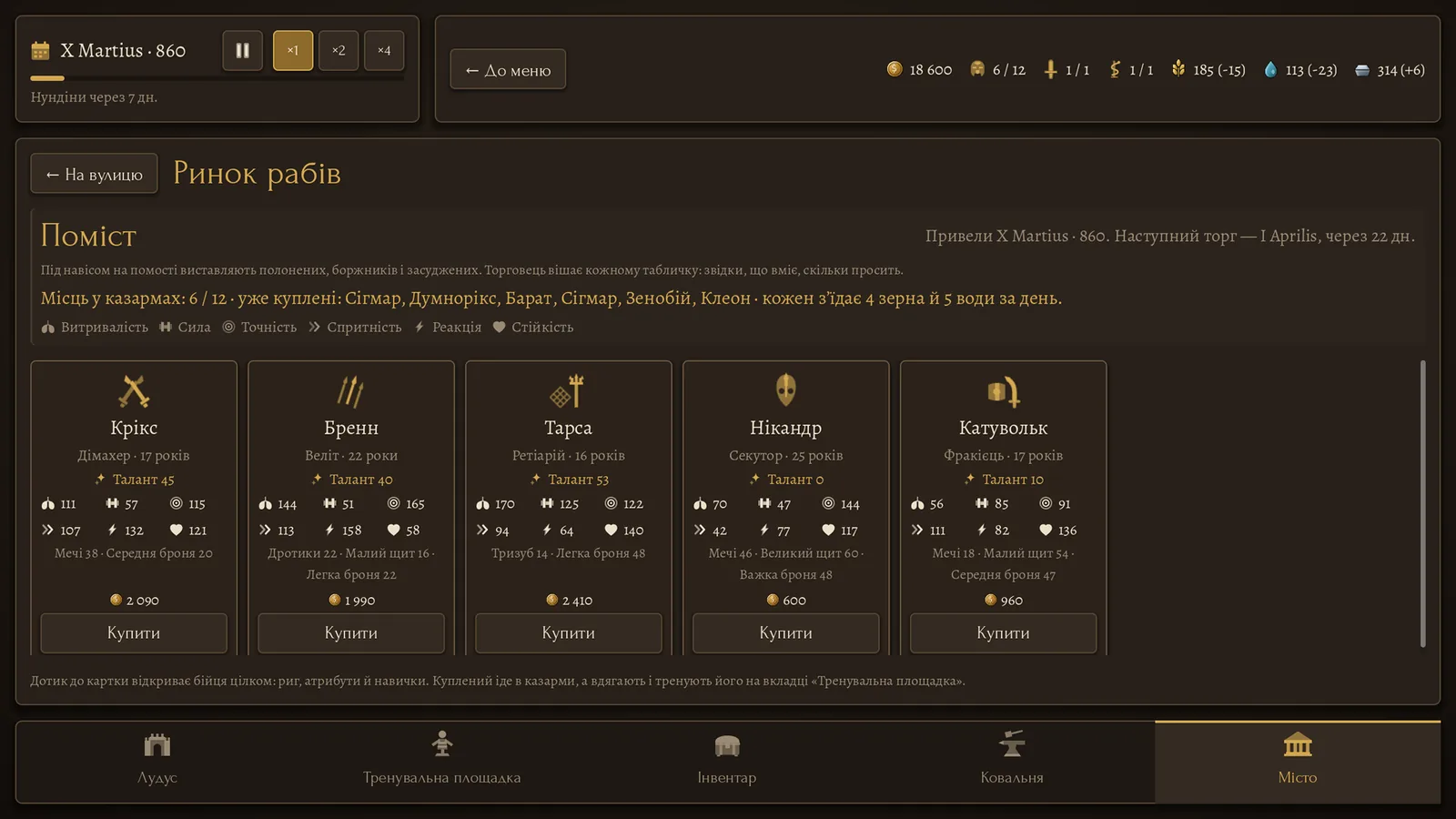
Once a month a caravan brings new slaves to the platform: six attributes, ten skills, and a talent, which is what the price is really set by. Everyone's numbers are miserable at first — the only one worth buying is the one who learns fast.
Every fighter is an expensive investment that can be lost in ten seconds on the sand, and at the same time a character with a name, a rig and a history of his own. The game keeps putting you between profit and the life of someone you know by name.
A historical detail works on the same tension: death in the arena was not the norm. Gladiators were expensive and took years to train, so the economy of the setting itself pushes you to protect your fighters, while greed and the pressure of patrons push the other way.
Every day
You feed them. Each fighter eats grain and drinks water every day, and so does the staff. A hungry day gives a fighter nothing: he simply does not train.
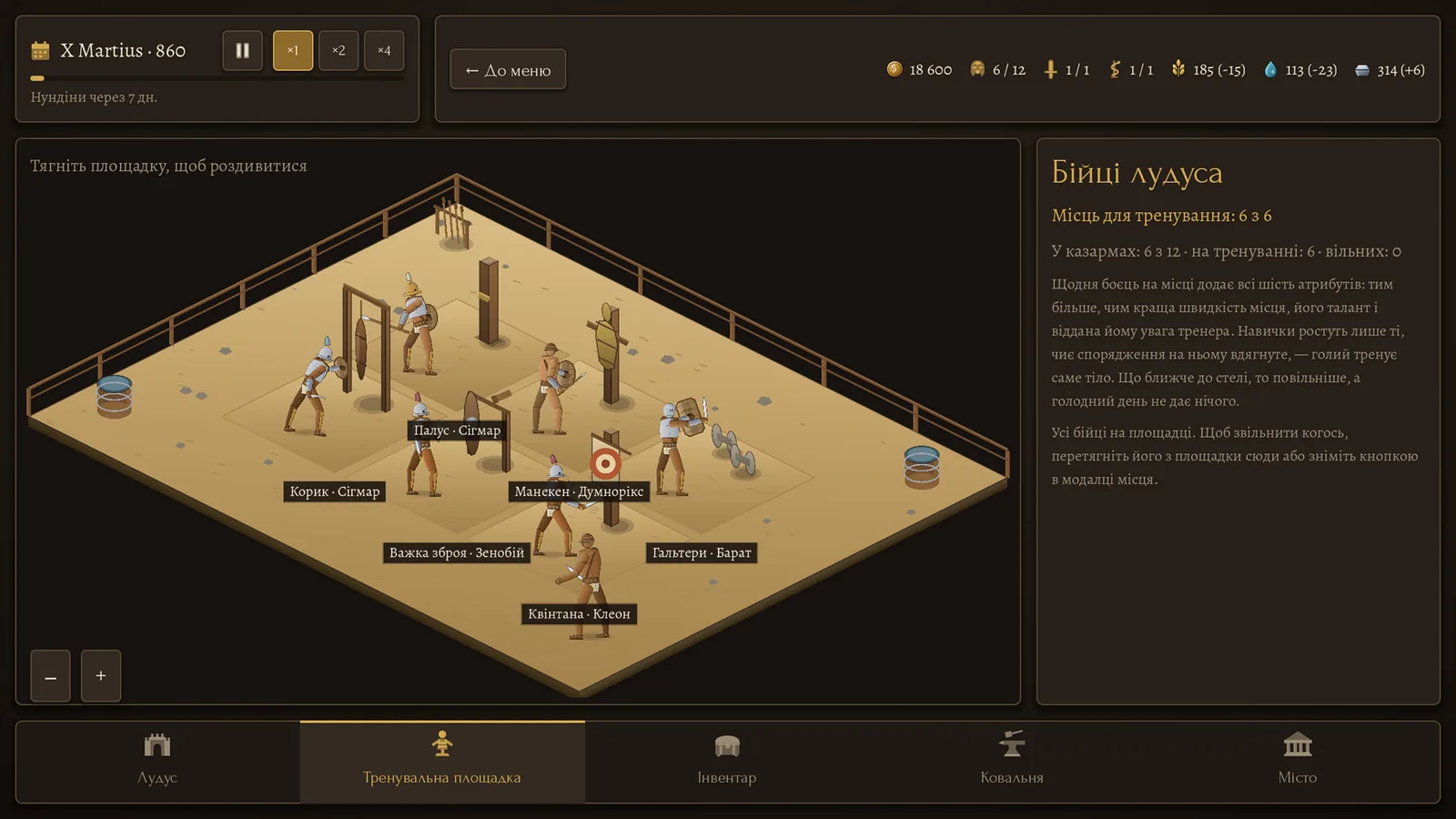
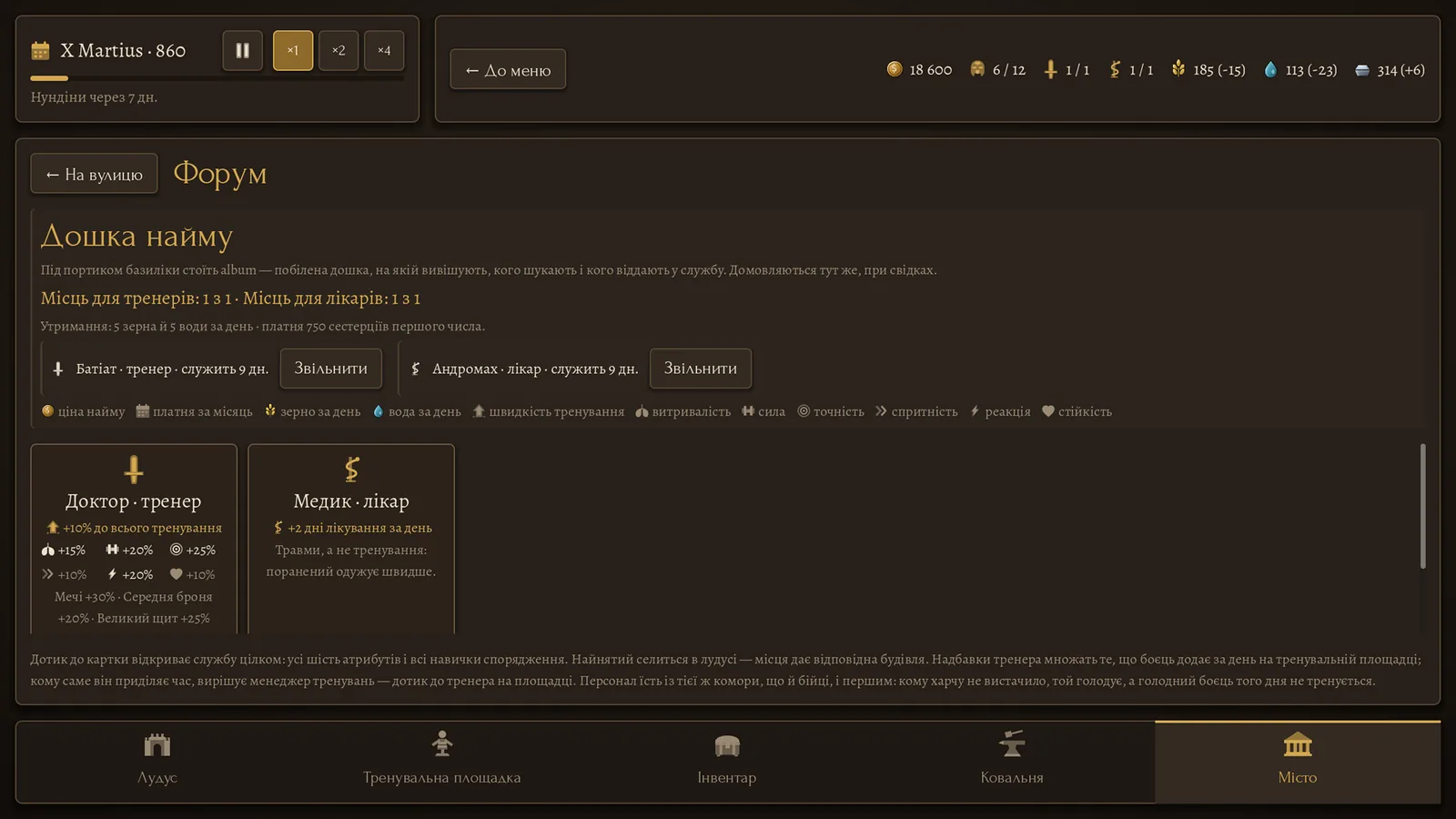
You train them. The yard holds the equipment — palus, corycus, quintain, halteres. Each accelerates its own attributes, and a hired doctore splits his attention between fighters: more attention, more growth.
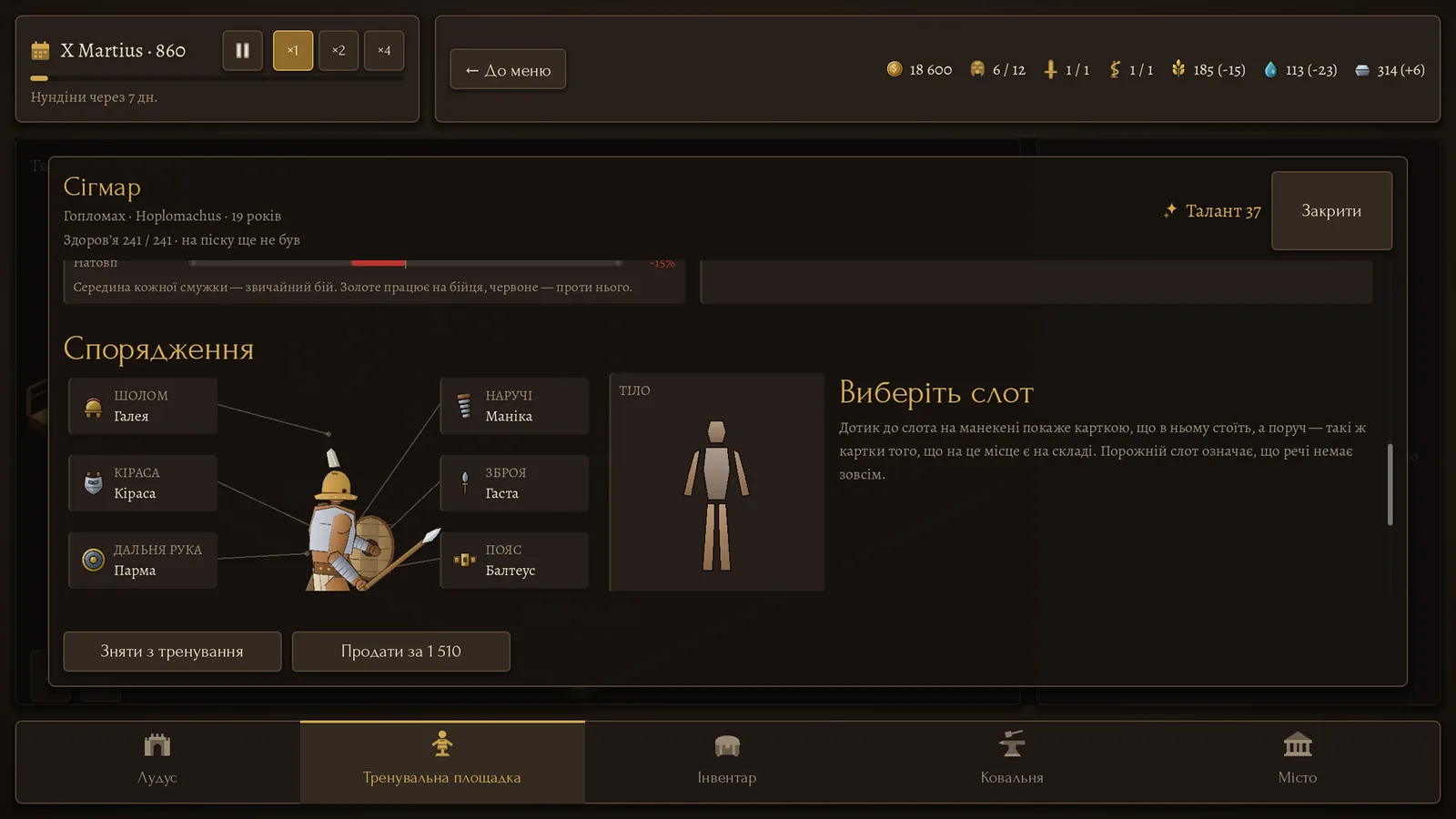
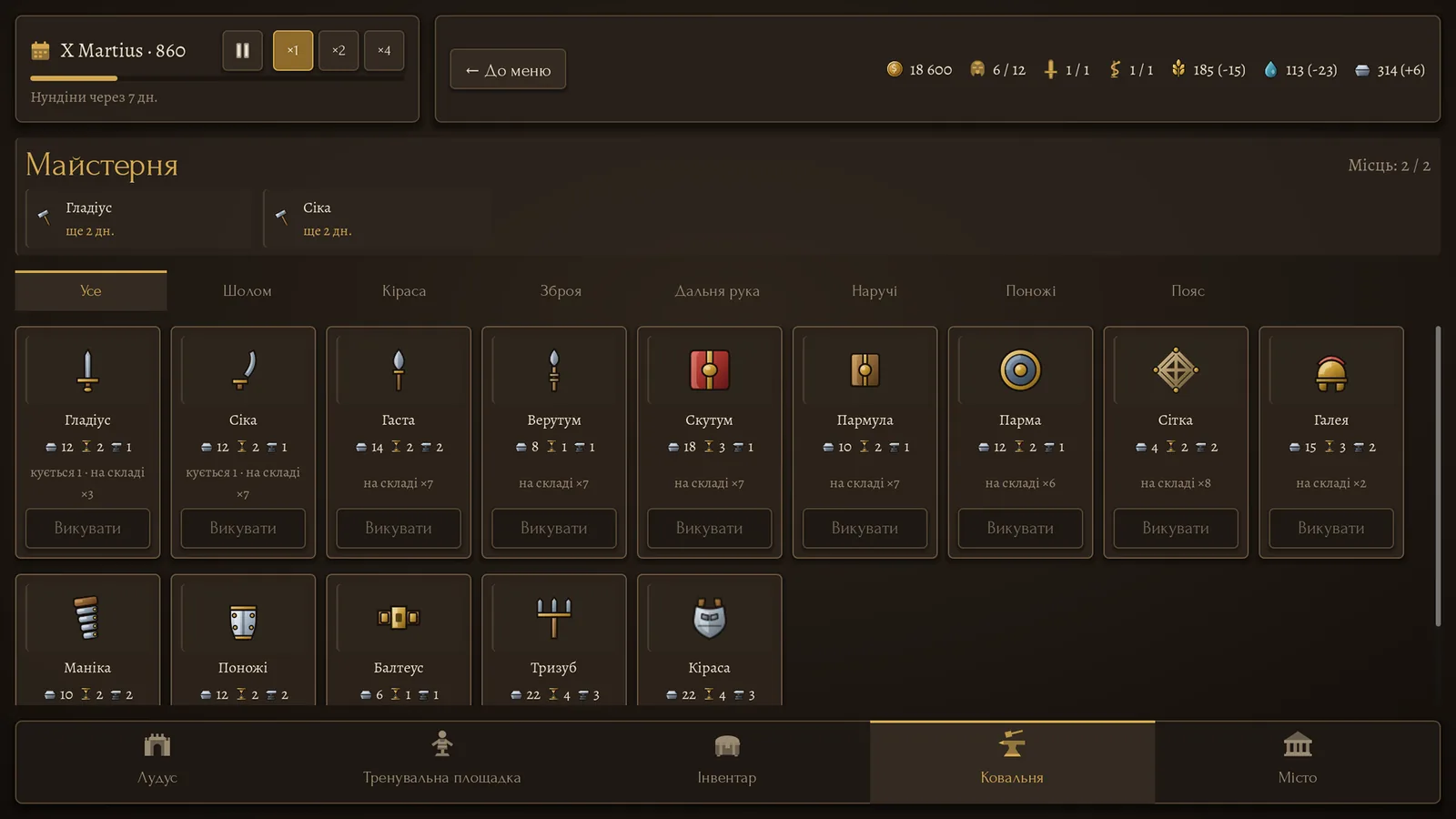
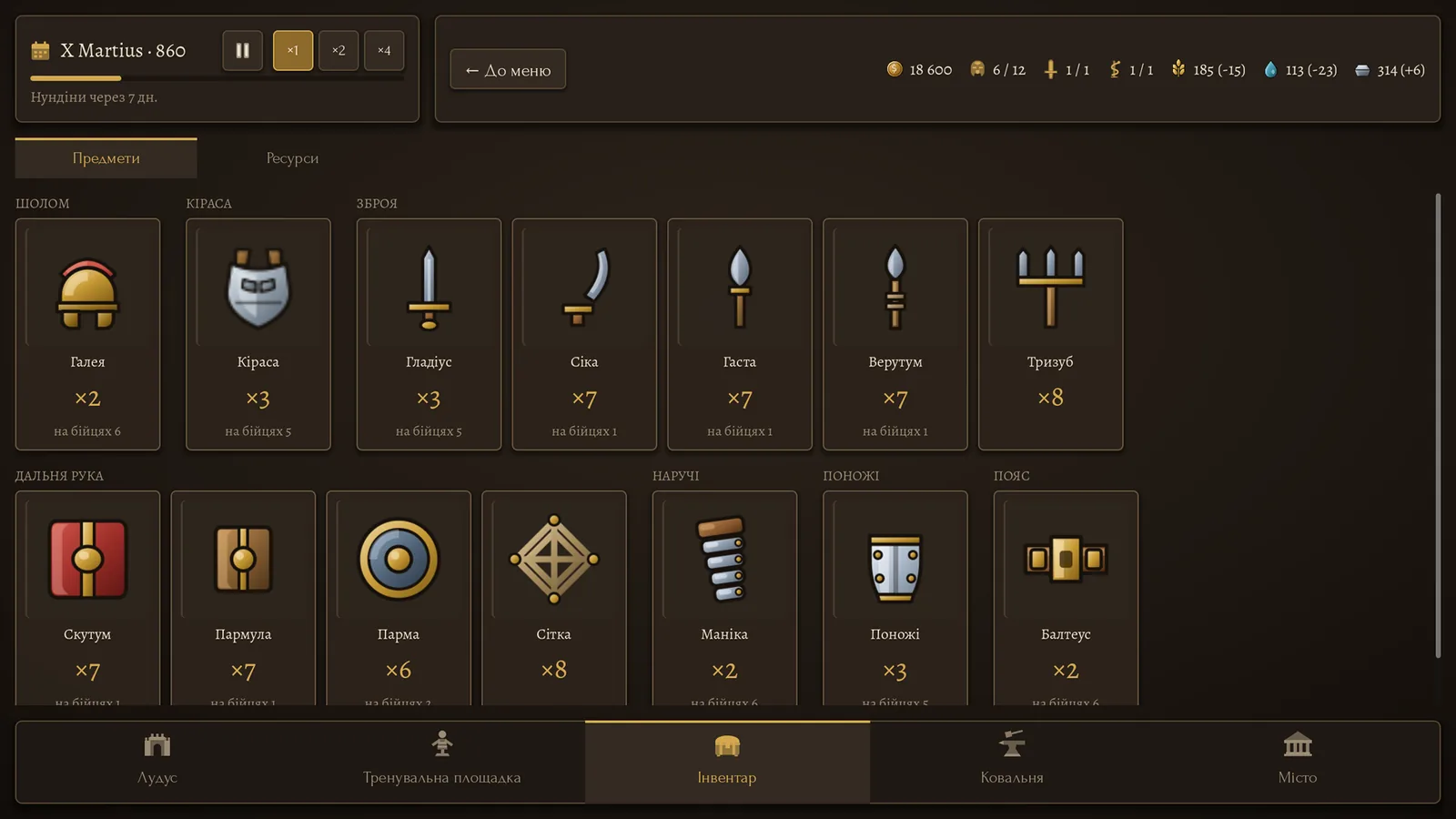
You arm them. Galea, scutum, manica, greaves, cuirass — all forged in the smithy for metal and days, or bought at the town armoury. Equipment decides how a fighter looks, which skills he picks up and which parts of his body are covered.
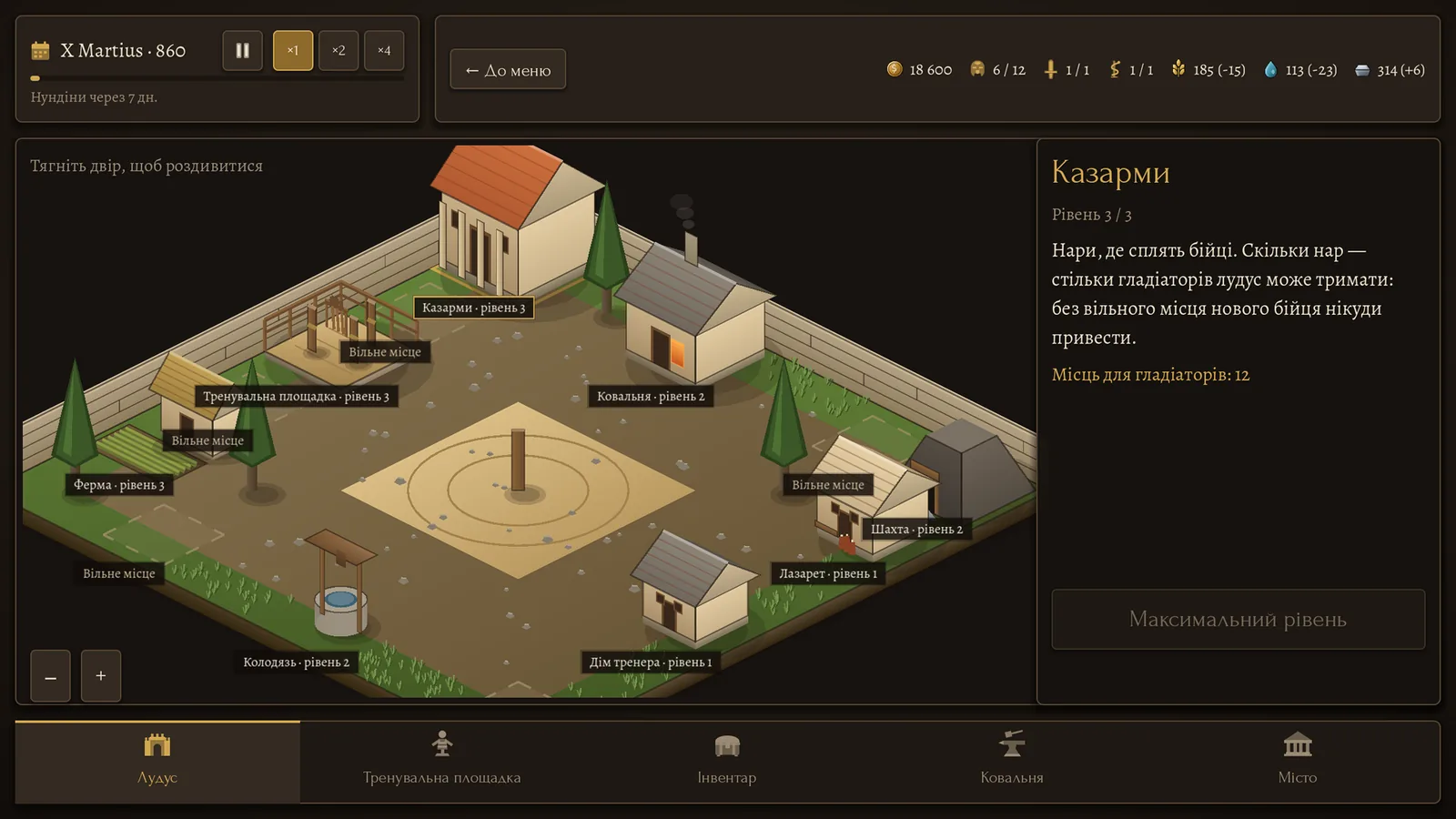
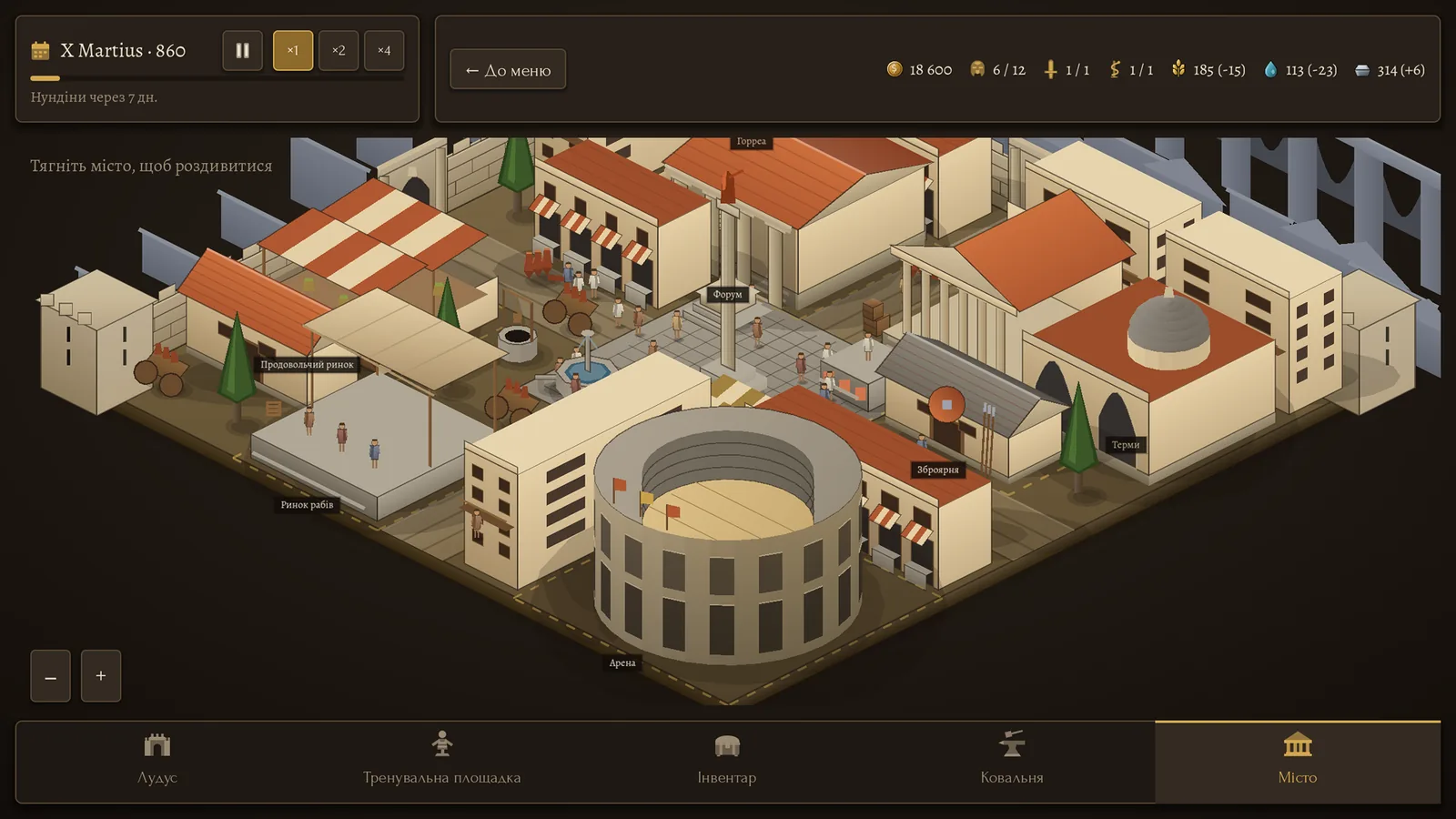
You build. Nine buildings stand in the yard: the dominus's villa, barracks, farm, well, mine, smithy, trainer's house, training ground and infirmary. Each has twenty levels, and none can be raised above the ludus itself — the villa sets the ceiling for the whole yard.
Fight day
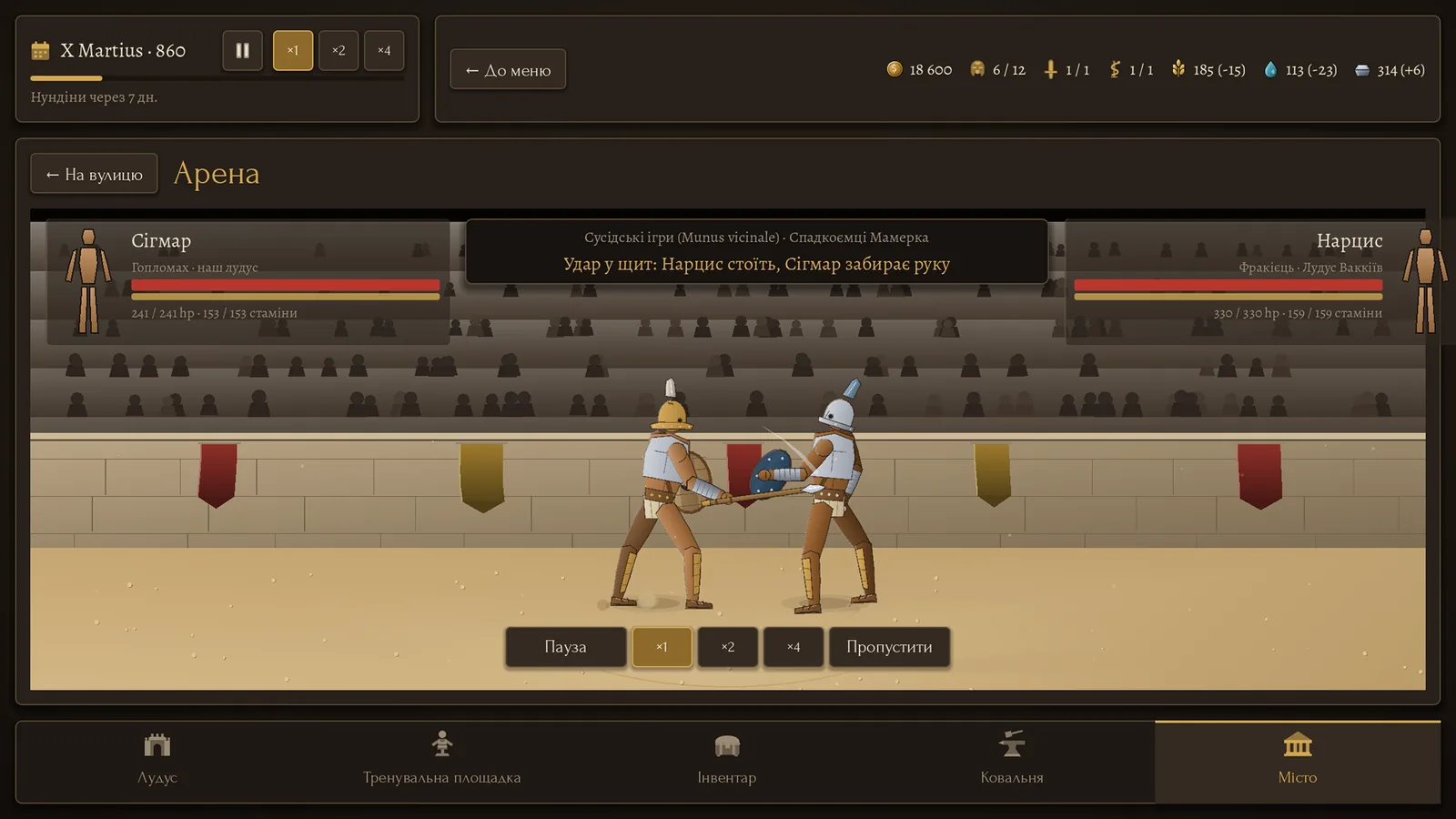
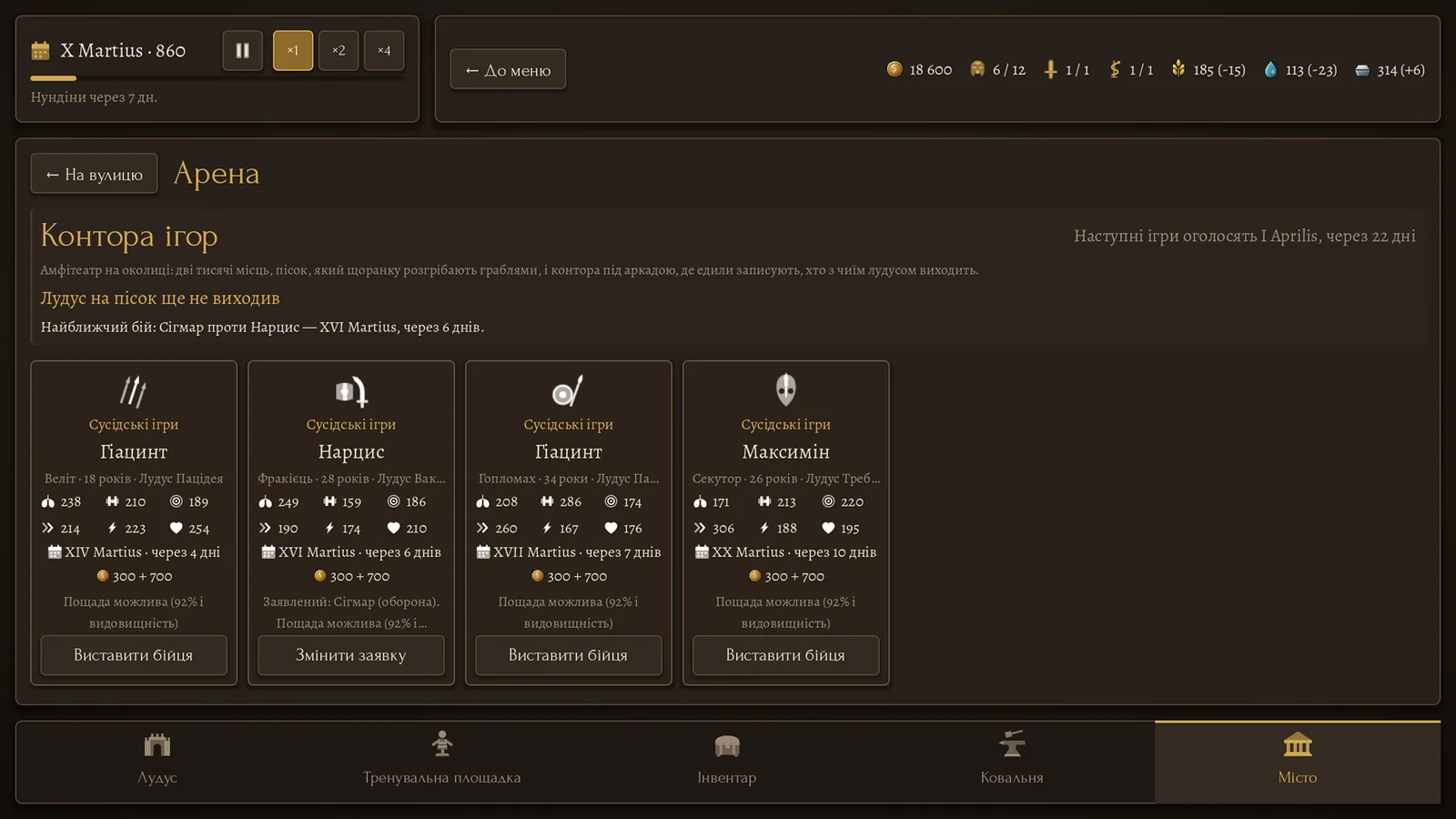
On the first of the month, along with the goods, two to four fight invitations arrive. Each is its own contract — rank, fee, prize money, rules — and an opponent already drawn from another ludus, whom you can inspect in full.
The fight happens on the appointed day. Once you sign up, your fighter trains and heals until then; when the day comes, time stops and all that is left is to walk out onto the sand. He goes out as he is — wounded, hungry, whatever. That is your call.
Before the fight you set his tactics: a style (pressure, defence or attrition), the threshold at which he will ask for mercy, whether to save stamina — and where to aim. During the fight you do not steer.
Six body modules
A fighter is divided into head, torso, two arms and two legs. This is a second layer over shared health: what kills is the shared pool, but damaged modules spoil the combat numbers — the head costs accuracy and reaction, torso and legs cost tempo, the right arm costs damage, the left costs blocking. Each module has its own integrity and its own armour, and a blow aimed at a narrow spot often slides into the one beside it.
A retiarius throws his net: once it lands, the opponent flounders for three seconds, but the net stays on him and the retiarius loses his block for the rest of the fight. A heavy blow can open a bleeding wound — it runs for five seconds and sometimes finishes the job. A fight ends in one of four ways: mercy, death, a decision on the exchange ceiling, or the victor's salute.
Time that needs no alarm clock
The Roman calendar: Julian months, years ab urbe condita, the eight-day nundinum. The caravan and the wages arrive on the first.
Time moves only while the game is open. No offline accrual, no timers demanding you come back at three in the morning. Wounds heal over days, and death in the arena is final.
Screenshots
Yard, sand and town
Tap any screenshot to enlarge it. Arrow keys move through the gallery.
Questions
Straight answers
Do you control the fights in Forge of Glory?
No. You set tactics before a fight — style, mercy threshold, stamina use and where to aim — and then watch it play out. The game is about running the household that produces a fighter, not about controlling him.
Can a gladiator die permanently?
Yes. Death in the arena is final, and the fighter is gone along with everything you invested in him. Wounds, by contrast, heal over days in the infirmary.
Does Forge of Glory have ads or in-app purchases?
Neither. There is no advertising, no real-money store and no subscription. Sesterces are earned only by fighting and running the ludus.
Does the game keep running when it is closed?
No. Time moves only while the game is open, so nothing accrues offline and no timer ever calls you back at an awkward hour.
How many buildings does a ludus have, and how far do they go?
Nine, with twenty levels each. But none can be raised above the level of the dominus's villa: it sets the ceiling for the whole yard.
Fair rules
- No ads. Not a banner, not a video.
- No in-app purchases. Sesterces are earned by fighting and by running the household.
- No network. The game never goes online and collects no analytics. Everything stays on your device.
- No offline timers. Time moves only while the game is open.
Details are in the privacy policy and the terms of use.